

Program Description
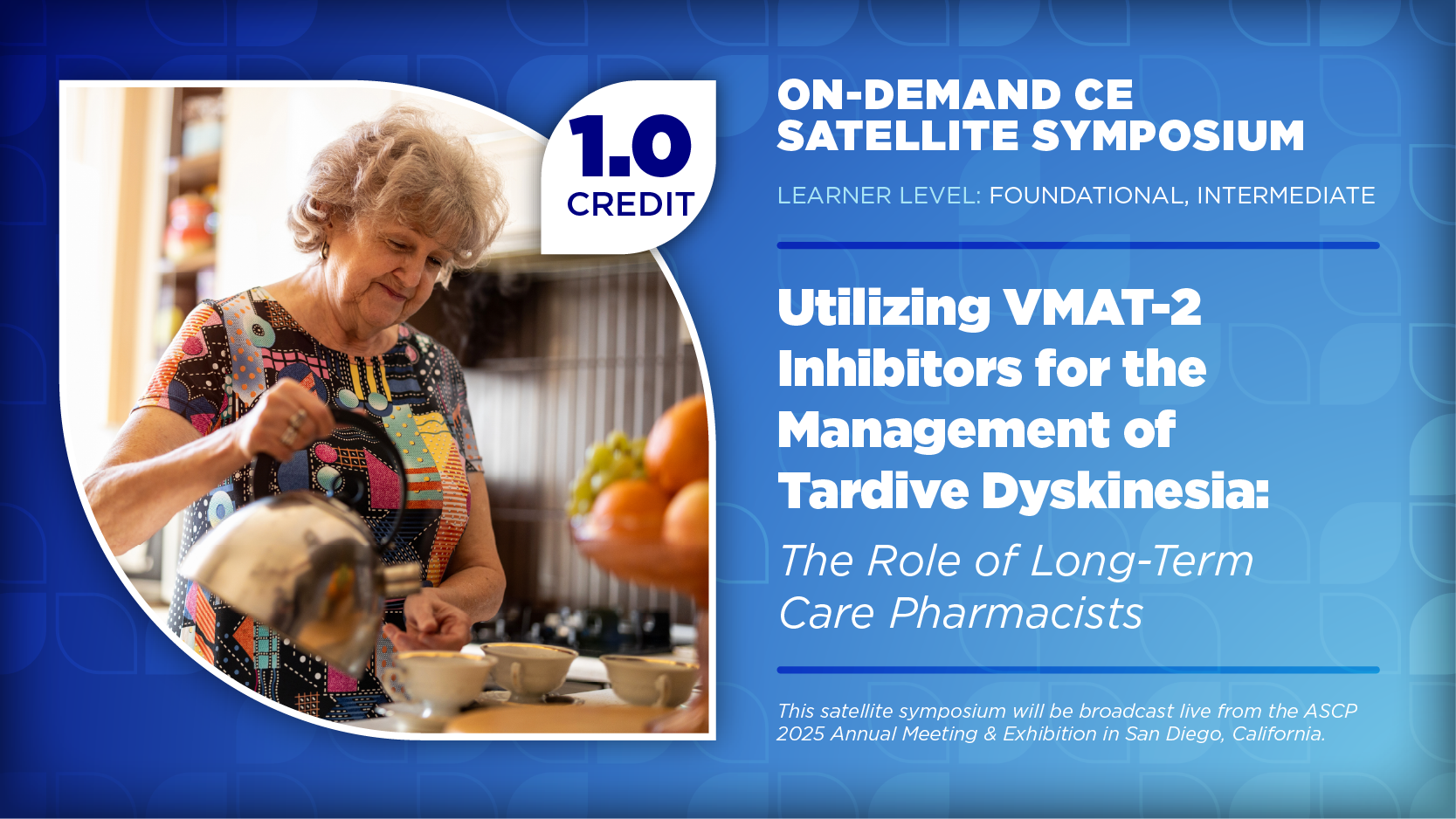
Tardive dyskinesia (TD) is a neurological hyperkinetic movement disorder characterized by involuntary movements, often caused by long-term use of dopamine receptor-blocking medications such as antipsychotics or antidepressants. Reversible vesicular monoamine transporter-2 (VMAT-2) inhibitors, including deutetrabenazine and valbenazine, are recommended as first-line treatments. Management of TD remains challenging, as prevention is not always possible and recognition is often delayed due to its insidious onset and overlap with underlying movement disorders. Patients over the age of 55 years are at increased risk due to polypharmacy, age-related physiological changes, and sensitivity to adverse effects of agents such as benzodiazepines and anticholinergics. TD carries clinical, economic, and psychosocial burdens, leading to increased health care utilization and a profound impact on quality of life. Long-term care and consultant pharmacists play a critical role in early recognition, evaluation of medication regimens, management of adverse effects, and improvement of the quality of life in patients at high risk for or living with TD. This activity will review the ongoing challenges in managing TD, the evolving treatment landscape with VMAT-2 inhibitors, and the vital role of pharmacists in optimizing education, adherence, and outcomes. Greater understanding of TD will enable pharmacists to improve early treatment initiation, reduce patient burden, and support effective long-term therapy.
Target
audience: Consultant Pharmacist, Specialty Pharmacist
Type of
activity: Application
Release date: October 31, 2025
Expiration date: October 31, 2026
Time to complete activity: 1.0 hours
Learner level: Foundational,
Intermediate
Fee: Free
Educational Objectives
At the completion of this activity, participants will be able to:
- Determine the unmet needs, challenges, and burdens of tardive dyskinesia (TD) and the impact of early recognition for minimizing the effects of TD
- Examine the professional guidelines, supporting data, and mechanism of action of the VMAT-2 inhibitors for treating TD
- Explore pharmacist interventions to improve patient education and adherence to medications in order to maximize the patient outcomes of those with TD

Steven Clark Stoner, PharmD, BCPP
Clinical Professor
Psychiatric Pharmacy Specialist
Associate Dean for Student Affairs
UMKC School of Pharmacy
Kansas City, MO

Pharmacy Times Continuing Education™ is accredited by the Accreditation Council for Pharmacy Education (ACPE) as a provider of continuing pharmacy education. This activity is approved for 1.0 contact hours (0.10 CEU) under the ACPE universal activity number 0290-0000-25-354-H01-P.The activity is available for CE credit through October 31, 2026.
Instructions for Completing the Activity and Receiving CPE Credit
To receive CPE credit, participants must complete the pretest, review the activity in its entirety, complete the posttest, and complete the online activity evaluation. After successful completion of the online activity evaluation, you can submit your credit to CPE Monitor. You may view your credit within 48 hours at www.mycpemonitor.net. All participants must request credit before the activity expiration date. CE credit will not be issued after this date.
Disclosures
Steven Clark Stoner, PharmD, BCPP, has the following
financial relationships with commercial interests to disclose:
Grant/Research Support: Otsuka
Consultant: Alkermes, Karuna Therapeutics, Sunovion, Teva
Speakers Bureau: Neurocrine, PsychU
The following contributors have no relevant financial relationships with commercial interests to disclose:
Faculty
Pharmacy Times Continuing Education™ Planning Staff—Jim Palatine, RPh, MBA; Liza Patel, PharmD; Katie Naspo; Susan Pordon; Brianna Winters; and Chloe Taccetta have no relevant financial relationships with commercial interests to disclose.
At
least one anonymous peer reviewer was used as part of content validation and
conflict resolution. The peer reviewer has no relevant financial relationships
with commercial interests to disclose.
Educational Disclaimer
CPE activities are offered solely for educational purposes and do not
constitute any form of professional advice or referral. Discussions concerning
drugs, dosages, and procedures may reflect the clinical experience of the
author(s) or they may be derived from the professional literature or other
sources and may suggest uses that are investigational in nature and not
approved labeling or indications. Participants are encouraged to refer to
primary references or full prescribing information resources.
For questions about this internet CPE activity, please contact:
ceinfo@pharmacytimes.com
Privacy Policy and Terms of Use Information:
www.pharmacytimes.org/terms
GET STARTED WITH THIS PROGRAM:
Register now to gain access to this program.
Create AccountAlready Registered? Login Here