

Program Description
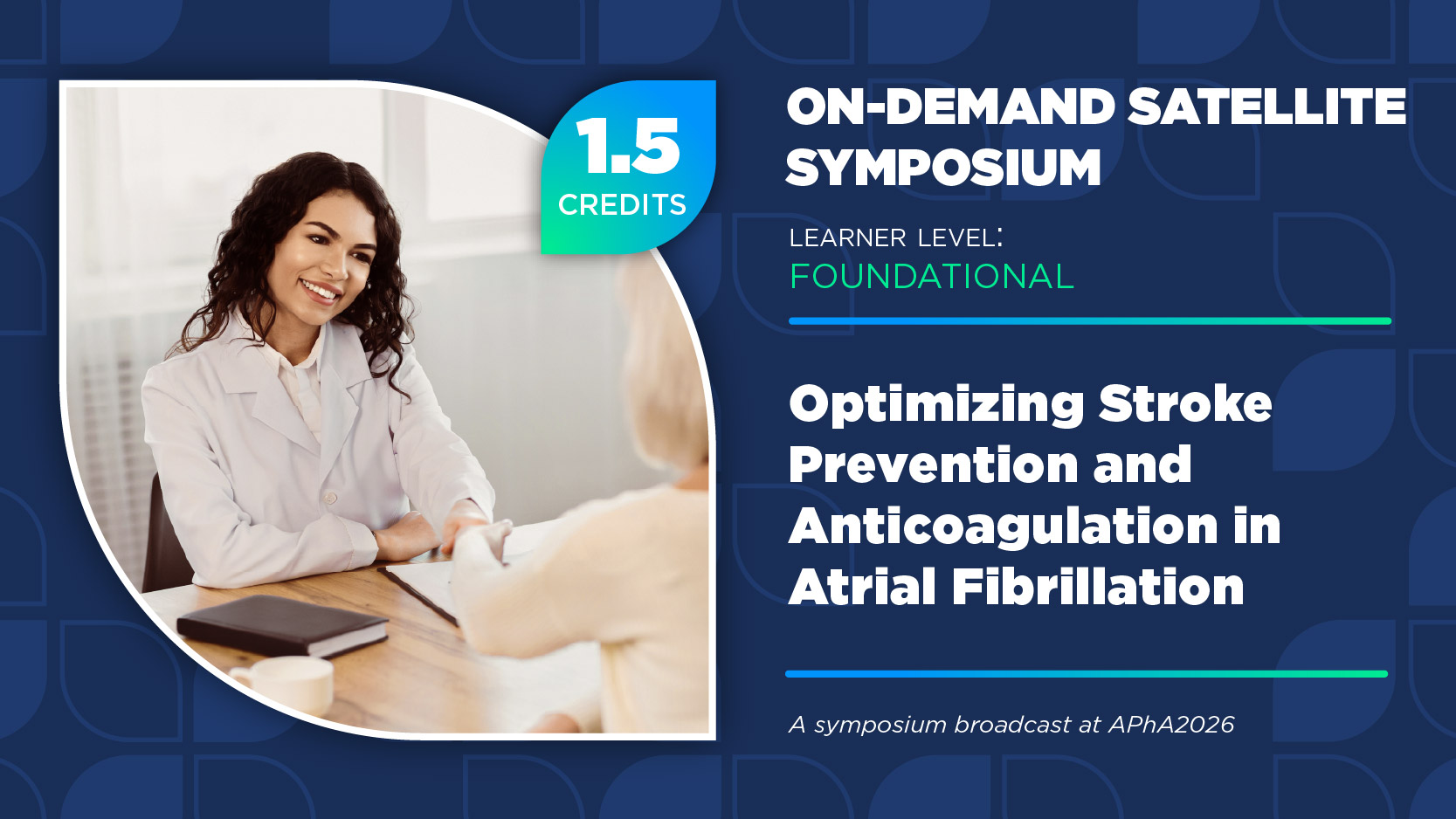
Atrial fibrillation (AFib) represents a critical challenge in clinical practice, as the arrhythmia is a major contributor to stroke. Early detection of AFib provides the opportunity to initiate treatment that could reduce the frequency of complications associated with it. However, management of AFib with direct oral anticoagulants (DOACs), vitamin K antagonists (VKAs), or heparin can increase risk of bleeding and recurrent stroke or another major adverse cardiovascular event. This session will examine factors contributing to undertreatment in AFib with current oral anticoagulants and review the pathophysiology of thromboembolism, the mechanisms, efficacy, and safety of currently approved anticoagulants, and the role of emerging Factor XI/XIa inhibitors with the potential to mitigate bleeding risk. Using case-based applications and pharmacist-patient counseling video vignettes within the session, participants will gain expertise in applying current guideline-based recommendations for stroke prevention, interpreting risk assessment, optimizing therapy selection and dosing, and implementing shared decision-making strategies to construct highly individualized treatment plans that mitigate bleeding risk and ensure optimal outcomes for patients with AFib.
Target audience: Ambulatory Care Pharmacist, Community Pharmacist
Type of activity: Application
Release date: April 10, 2026
Expiration date: April 10, 2027
Learner level: Foundational
Time to complete activity: 1.5 hour
Fee: Free
Educational Objectives
At the completion of this activity, participants will be able to:
- Explain the pathophysiology of thromboembolism and stroke risk in atrial fibrillation
- Compare the mechanisms, efficacy, and safety of approved and emerging anticoagulants, including Factor XI and XIa inhibitors
- Employ guideline-based strategies to reduce stroke and systemic embolism risk, incorporating risk assessment, therapy selection, and patient-centered care
- Construct individualized treatment plans for patients with atrial fibrillation using evidence-based recommendations and shared decision-making
Tara Lech, PharmD, CACP
Director of Anticoagulation Services
Beth Israel Lahey Health
Board of Directors, Anticoagulation Forum
Co-Chair, Medical Advisory Board
Vasculearn Network
Burlington, MA
Gabe Fontaine, PharmD, MBA, BCPS, BCCCP, FNCS, FCCM
Clinical Pharmacy Manager/Clinical Pharmacist
Division of Critical Care, Emergency Medicine, and Telecritical Care
Associate Professor
Division of Neurosciences and Critical Care
Intermountain Health
Salt Lake City, UT

Pharmacy Times Continuing Education™ is accredited by the Accreditation Council for Pharmacy Education (ACPE) as a provider of continuing pharmacy education. This activity is approved for 1.5 contact hours (0.15 CEU) under the ACPE universal activity number 0290-9999-26-049-H01-P. The activity is available for CE credit through April 10, 2027.
Instructions for Completing the Activity and Receiving CPE Credit
To receive CPE credit, participants must complete the pretest, view the activity in its entirety, complete the posttest, and complete the online activity evaluation. After successful completion of the online activity evaluation, you can submit your credit to CPE Monitor. You may view your credit within 48 hours at www.mycpemonitor.net. All participants must request credit before the activity expiration date. CE credit will not be issued after this date.
Faculty
Gabe Fontaine, PharmD, MBA, BCPS, BCCCP, FNCS, FCCM, has the following relevant financial relationships with ineligible companies to disclose:
Consultant: Alexion, Annexon Biosciences, Bayer, Chiesi,
Grifols, SERB Pharmaceuticals
Speakers Bureau: Alexion, Chiesi
The following contributors have no relevant financial relationships with ineligible companies to disclose:
Faculty
Tara Lech, PharmD, CACP
Pharmacy Times Continuing Education™ Planning Staff—Jim Palatine, RPh, MBA; Liza Patel, PharmD, RPh; Katie Naspo; Susan Pordon; Brianna Winters; and Chloe Taccetta have no relevant financial relationships with ineligible companies to disclose.
University of Connecticut School of Pharmacy–Storrs Planning Staff: Jeannette Y. Wick, RPh, MBA, FASCP; and Heather Kleven, MME, have
no financial relationships with ineligible companies to disclose.
Any relevant financial relationships listed for these individuals have been mitigated.
At least one anonymous peer reviewer was used as part of content validation and conflict resolution. The peer reviewer has no relevant financial relationships with ineligible companies to disclose.
Educational Disclaimer
Continuing professional education activities are offered solely for educational
purposes and do not constitute any form of professional advice or referral.
Discussions concerning drugs, dosages, and procedures may reflect the clinical
experience of the author(s) or be derived from the professional literature or
other sources and may suggest uses that are investigational in nature and not
approved by the labeling or indications. Participants are encouraged to refer
to primary references or full prescribing information resources.
For questions about this internet CPE activity, please contact:
ceinfo@pharmacytimes.com
Privacy Policy and Terms of Use Information:
www.pharmacytimes.org/terms
GET STARTED WITH THIS PROGRAM:
Register now to gain access to this program.
Create AccountAlready Registered? Login Here